
CritDRS · in development
Decision review for the cricket that has never been able to afford it.
Review technology stops at international and premier-league cricket for one reason: it costs $20,000 to $30,000 a day and needs a crew of fifteen to twenty. CritDRS adjudicates pitching, impact and wickets from the same tracked trajectory Chrio already uses for live shot analysis, without a dedicated review crew.
Status: in development
Ball tracking is built and running in production inside CritShot. Collision detection and multi-view fusion are the current focus. This page describes what is built, what is not, and what a pilot would involve.
The problem
A review day costs more than most domestic seasons can carry.
Decision review is a crew business. Ball-tracking cameras, an operator per camera, a review official, a truck and the people to rig it, all of it travelling with the fixture. Published figures put a review day at $20,000 to $30,000, with even a stripped-down four-camera setup starting around $12,000 to $15,000 a day, and Test-match technology running considerably higher.
Multiply that by a domestic season and the arithmetic answers itself. A forty-fixture competition would spend more on review technology than on everything else combined, so it goes without, and the umpiring controversies that follow are treated as an unavoidable feature of cricket below the top tier rather than a budget line nobody could meet.
The technology is not scarce. The crew is.
Where the money goes
Most of a review day's cost is people and logistics, not computation.
Break a review day down and the compute is the cheap part. The expense is a specialist crew, their travel, their accommodation and the truck they work from, all moving with the competition.
| Cost driver | Traditional review setup | CritDRS approach |
|---|---|---|
| Camera operators | One per tracking camera | None: fixed calibrated cameras |
| Review official or analyst | Dedicated on site | The match official, on a device |
| Production truck | Required | None: one workstation |
| Travel and accommodation | Whole crew, every fixture | One operator, or none once installed |
| Rig and de-rig | Hours per fixture | Under an hour from arrival, on the CritShot rig |
| Computation | Dedicated hardware | One workstation, one GPU |
That is the whole argument. Chrio is not claiming better physics than an incumbent system. It is claiming that the physics can run without the crew, and that removing the crew is what moves review technology down a tier.
How it works
Three checks, from one reconstructed trajectory.
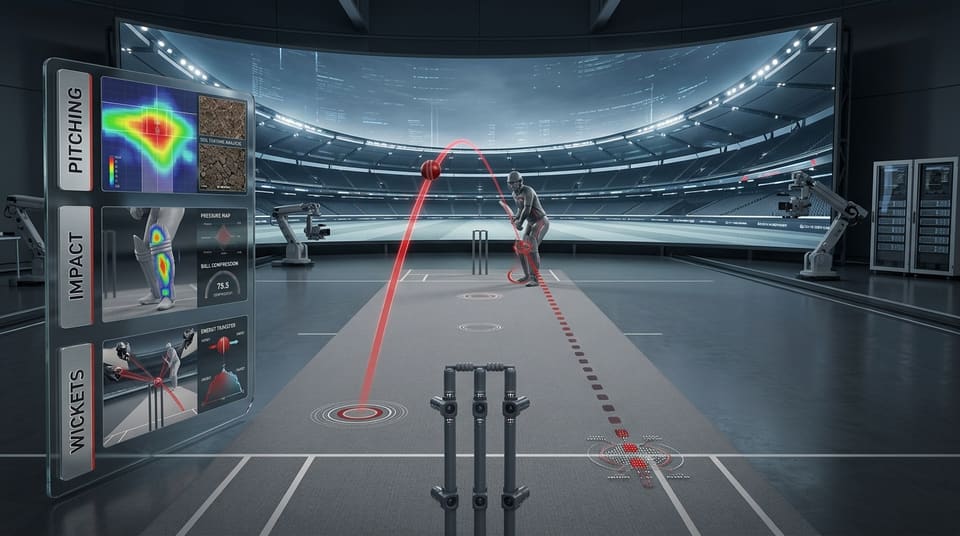
CritDRS reconstructs the ball's flight in three dimensions from calibrated cameras, then answers the three questions a review asks.
- Pitching
- Where the ball landed, relative to the line of the stumps. Reconstructed from the tracked trajectory rather than inferred from a single camera angle.
- Impact
- Where the ball met the pad, and whether that point was in line.
- Wickets
- The projected path after impact, and whether it was going on to hit.
The trajectory comes from the same tracking that already runs in production inside CritShot. The prototype rig behind CritDRS uses three calibrated cameras feeding a vision engine at 50 fps, which reconstructs release, pitching, impact and projected path with live speed.
Status
What is built, what is not, and what that means for a pilot.
| Component | Status |
|---|---|
| Ball detection and tracking | Built. Running in production inside CritShot. |
| 3D trajectory reconstruction | Built on the prototype rig. Release, pitching, impact and projected path, at 50 fps. |
| Collision detection | In development. Current focus. |
| Multi-view fusion | In development. Current focus. |
| Umpire review workflow | Concept. The device and review-centre screens shown on this page are pre-MVP concepts with fictional teams and players. |
| Accredited match use | Not yet. CritDRS has not been used to adjudicate a competitive fixture. |
That last row matters, so it is stated plainly rather than left to be inferred. A review system that changes match outcomes has to earn its accreditation, and Chrio is not claiming to have earned it.
A first deployment
What a first deployment would look like.
A CritDRS pilot is a fixture or a short competition, run alongside the existing umpiring process rather than replacing it, so decisions can be compared without any consequence to the result.
- 01
Ground survey and calibration
Camera positions confirmed against the pitch and the sightscreens.
- 02
Shadow running
CritDRS produces a verdict on every appeal; the on-field decision stands. Both are logged.
- 03
Comparison
Agreement rate, disagreement cases and failure modes reviewed together with the competition's officials.
- 04
Decision
Whether to extend, adjust or stop, made on the evidence from step three.
Questions
Before you get in touch.
Is CritDRS available now?
No. Ball tracking is built and in production; collision detection and multi-view fusion are in development. What is available now is a pilot conversation and an honest assessment of whether your competition is a fit.
How does it compare with an established DRS system?
On physics, an established system has a twenty-year head start and accreditation Chrio does not have. On economics, CritDRS is designed to run without the crew and the truck, which is what puts review technology within reach of a domestic competition. If your budget can carry a conventional system, buy one.
What does it need from the ground?
Calibrated camera positions with a clear view of the pitch, and power. The exact camera count and mounting specification are settled during the ground survey.
Who makes the final decision?
The match officials. CritDRS produces the three checks and a verdict; what happens with it is a competition's own regulation to write.
What does it cost?
Pilot pricing is discussed case by case, because the ground survey drives most of it. For context on the alternative: a conventional review day runs $20,000 to $30,000 before logistics.
The prototype · Hawkeye-X
Every delivery detected, its full flight reconstructed in 3D.
The pre-MVP rig behind CritDRS. Three calibrated cameras, synchronised to 0.0 ms drift, feed a vision engine running at 50 fps that reconstructs each ball's flight in three dimensions: release, pitching, impact and projected path, with live speed.
The proposed umpire workflow runs on one device. Glasses capture every ball, the stream syncs to the umpire's tablet, the tracked delivery plays back in the review centre, and a three-check verdict goes to the broadcast and the scorecard together.
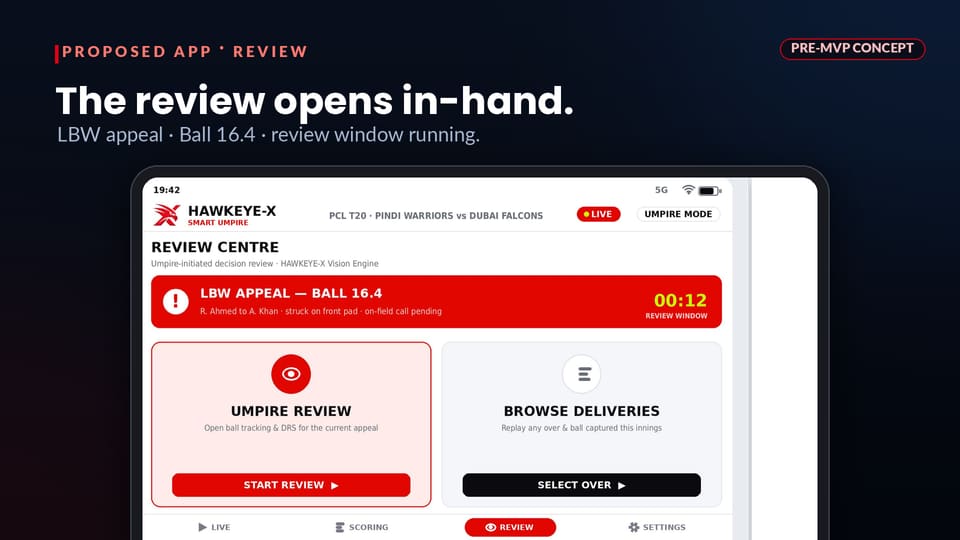
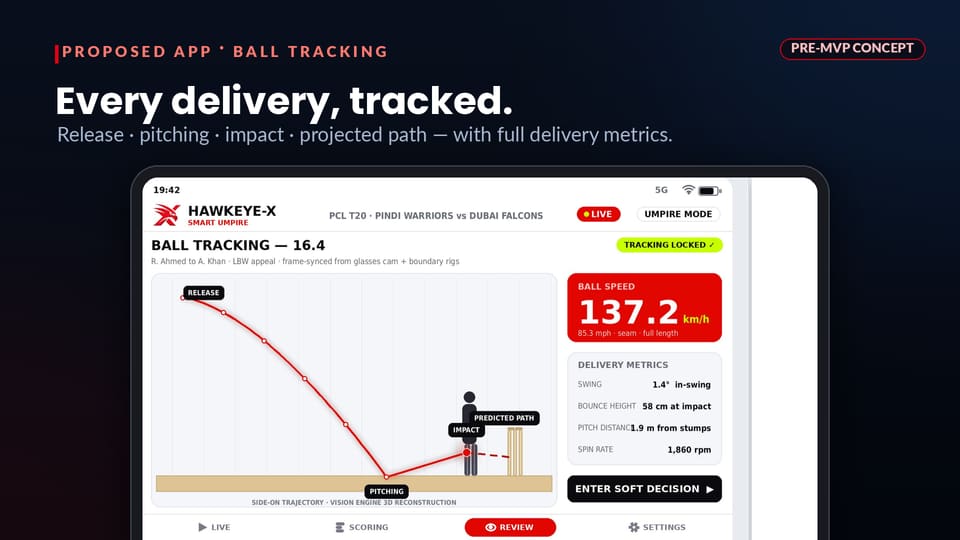
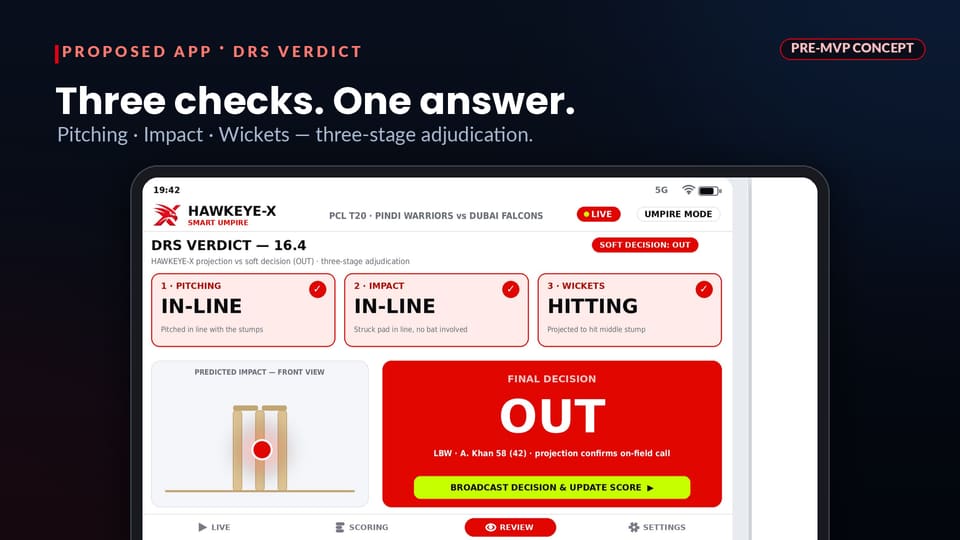
App screens are pre-MVP concepts with fictional teams and players. The trajectory reconstruction and telemetry are from the working test rig.